






Uncategorized
Sourcing Guide: Maximizing Profit with a Premium Robot Toy Remote and Branded Batman Robot Toy Line
Jun
Introduction: The High-Margin Opportunity in Smart Tech Toys
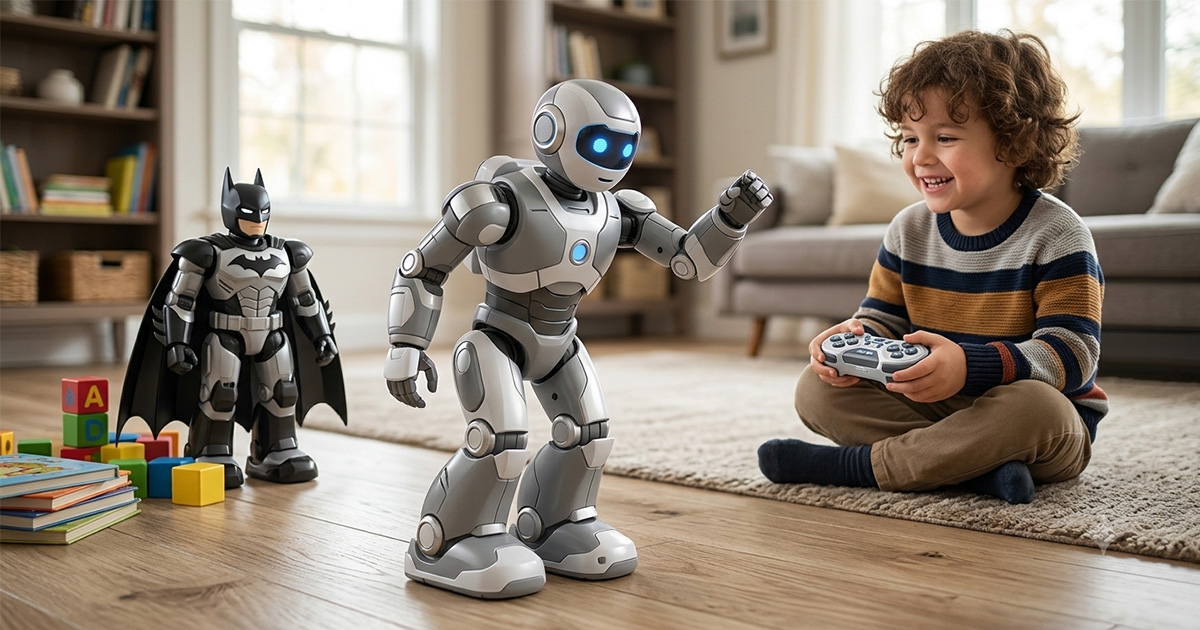
The global toy industry is undergoing a structural paradigm shift. Traditional, static action figures are losing retail shelf space to interactive, multi-functional novelties. For B2B buyers, sourcing agents, and major e-commerce importers, identifying products that combine remote-control capabilities with iconic character branding is the key to capturing high retail margins. Today, the products leading the charge in retail velocity are high-performance robot toy remote platforms and specialized batman robot toy variants.
For import companies and procurement professionals, navigating this specialized niche requires deep technical insight into supply chains, circuit components, wireless protocols, and licensing landscapes. This comprehensive guide will dissect the manufacturing ecosystems behind interactive tech toys, analyze cost structures, and provide a roadmap to de-risk your next manufacturing run in Southern China’s tech hubs.

2. Analyzing Market Demand: Why RC & Superhero Robots Dominate
Consumer behavior data indicates that high interactivity—specifically multi-channel wireless control, programmable movements, and iconic pop-culture branding—increases a toy’s shelf appeal by over 45% compared to non-electronic counterparts. Products incorporating beloved licensing elements, such as a dedicated batman robot toy, leverage pre-existing global fandoms. This structural advantage drastically reduces direct-to-consumer advertising costs for international distributors and retail brands alike.
From a commercial standpoint, these products offer exceptional retail markups. A high-quality robot toy remote sourced at an OEM price point of $5.50 to $11.50 USD frequently commands retail prices between $29.99 and $55.00 USD across Western marketplaces. This price resilience stems from perceived technological value: parents and tech-savvy gift buyers perceive programmable, remote-driven superhero hardware as premium, future-ready assets.
3. Anatomy of a Bestseller: Technical Specifications and Features
To ensure high performance and minimize product return rates (RMA), professional buyers must understand the internal Bill of Materials (BOM) of a premium robot toy remote. A durable build is defined by concrete engineering specifications rather than marketing copy.
Key Sourcing Performance Metric: Always specify 2.4GHz high-frequency RF modules for your wireless remotes instead of outdated 27MHz/40MHz infrared components. 2.4GHz ensures anti-interference operations, allowing multiple robots to run simultaneously within a single retail display or household setting.
Importers should demand the following technical framework from their manufacturing partners:
- Microcontroller Unit (MCU): Minimum 12-bit or 32-bit IC chips capable of processing multiple real-time remote commands, audio-to-motor sync, and programmable motion sequences.
- Actuators & Servos: High-torque, nylon-geared or partial-copper mini-servos inside the limbs to prevent gear stripping during rapid walking, turning, or arm-firing mechanics.
- Sound Module: 8Ω 1W mini internal speakers utilizing clear, digital flash memory storage instead of low-cost, distorted COB (Chip-on-Board) voice components—essential for character lines in a batman robot toy.
- Material Composition: High-impact virgin ABS (Acrylonitrile Butadiene Styrene) resin casing to ensure structural integrity during standard drop testing protocols (EN71 / ASTM F963).
4. Decoding the Supply Chain: Finding OEM/ODM Factories in China
When sourcing precision tech toys, geographic alignment is critical. Over 80% of the world’s electronic components and smart educational toys are developed across the industrial clusters of Guangdong Province. Specifically, buyers looking for high-end electronic integrated circuits, custom programming, and advanced multi-channel robot toy remote configurations should target tech hubs in Shenzhen. Conversely, those seeking mass-scale structural injection molding and standard sound-and-light mechanisms should look to the industrial belts of Chenghai (Shantou).
| Region Hub | Core Industrial Strength | Ideal Order Type | Target Unit Cost |
| Shenzhen (Bao’an / Longgang) | Advanced PCBA layouts, high-end AI components, complex wireless RF integration, custom programming. | High-end programmable premium items, ODM custom solutions, advanced RC. | $12.00 – $25.00 USD |
| Chenghai (Shantou) | Mass injection molding, rapid toy prototyping, competitive assembly labor, standard sound/light setups. | High-volume retail campaigns, standard walking models, OEM white-labeling. | $4.50 – $11.00 USD |
When vetting potential suppliers on global B2B platforms, it is important to filter out small trading companies masquerading as direct manufacturers. Legitimate factories will freely provide access to their injection molding workshops, SMT (Surface Mount Technology) lines for circuit board production, and ISO 9001 quality management certifications.
5. Navigating Compliance, Certifications, and IP Barriers
Procuring automated electronics and branded character variants introduces dual layers of strict operational compliance: mechanical/electrical toy safety standards and Intellectual Property (IP) verification.
Mechanical, Electrical, and RF Certifications
To pass customs clearance in North American and European jurisdictions, your shipment must display certified compliance documentation from an accredited third-party laboratory (such as SGS, Intertek, or TUV Sud). Ensure your supplier contract mandates:
- United States: ASTM F963 (Standard Consumer Safety Specification for Toy Safety), CPSIA (Lead/Phthalate thresholds), and FCC Part 15 certification for wireless remote controllers.
- European Union: EN71 (Parts 1, 2, and 3), CE Marking, RED (Radio Equipment Directive) for the remote frequencies, and RoHS compliance.
- Battery Safety: For rechargeable lithium-polymer variants built into the robot chassis, verified UN38.3, MSDS, and IEC 62133 certifications are mandatory for ocean and air transit.
Intellectual Property (IP) Clearance
Products depicting trademarked or copyrighted properties like a batman robot toy require clear chain-of-custody licensing documentation. If you are importing white-label designs, make sure the aesthetic appearance shifts sufficiently away from proprietary geometry (such as custom cowls, bat insignia, or copyrighted character lines) to eliminate the risk of customs seizures at the port of entry.
6. Quality Control Metrics: What Importers Must Inspect
An experienced sourcing agent knows that electronic toys face some of the highest defect rates during mass production if left unmonitored. Establishing a definitive Quality Control (QC) checklist for your Pre-Shipment Inspection (PSI) is critical to protect your capital. Your inspection agent should focus heavily on the following variables:
Critical Inspection Checkpoints
- Wireless Range & Binding Test: Confirming the remote control smoothly pairs with the robot and maintains a functional signal radius of at least 15–20 meters without dead zones.
- The 3-Foot Drop Test: Dropping both the robot unit and the remote from 3 feet onto a concrete floor across 5 distinct angles to confirm no structural cracks or loose internal wiring occur.
- Motor Stall Verification: Ensuring that restricting the limbs manually while the remote motor is running does not cause circuit overheating or component smoke.
Common Production Flaws to Flag
- RF Signal Drifting: Poorly calibrated quartz crystal oscillators in the remote or receiver causing sluggish or completely missed commands.
- Cold Solder Joints: Loose connections on the internal PCBA causing intermittent function loss after vibrations during shipping.
- Misaligned Gears: High-pitch mechanical grinding noises pointing to poor calibration of internal motor assemblies.
7. Comparative Sourcing Analysis: Remote Control vs. Branded Hero Variants
Importers must carefully evaluate product formats to balance upfront manufacturing costs against logistical realities and market velocity:
Multi-Channel Robot Toy Remote Formats
A true multi-functional RC setup integrates an external 2.4GHz RF or infrared controller. This architecture opens up a more advanced market tier, allowing for customized motion program maps, directional tracking, and interactive missile-firing or dancing mechanics. However, this configuration adds a separate controller shell to your BOM and doubles battery cell requirements, which increases overall package volumes and weight metrics.
Branded Character Variants (e.g., Batman Robot Toy)
Sourcing character-centric designs drastically enhances click-through rates (CTR) on e-commerce platforms and commands higher retail price thresholds. The trade-off is the strict verification of licensing chains or the engineering investment required to design a distinct, non-infringing “cyber-hero” equivalent that mimics the highly sought-after aesthetic without breaking copyright laws.
8. Logistics and Sourcing Agent Strategies
If you are managing an import enterprise with strict volume targets, working alongside a native sourcing team on the ground in China provides structural advantages over remote purchasing. Sourcing professionals execute raw material cost verifications, handle direct localized negotiations, and implement corrective factory action plans before final balances change hands.
When engineering product packaging designs for global transit, maximize volumetric shipping densities. Standard display windows look highly appealing in traditional brick-and-mortar stores, but they leave open, empty volumes inside master cartons. For e-commerce fulfillment operations, require your manufacturing facility to utilize robust, custom-fitted corrugated paperboard mailer cartons. This shift cuts internal air volume, reduces dimensional freight weights by up to 35%, and guarantees full protection for both the robot and its accompanying remote control during regional last-mile delivery shipments.
9. Frequently Asked Questions (FAQ) Section
Q1: What is the standard Minimum Order Quantity (MOQ) when sourcing a custom robot toy remote in China?
- A1: For standard white-label RC robots with custom color configurations, factories usually require an MOQ of 1,000 to 2,000 units. If your distribution plan requires a complete structural modification or custom injection molds for a unique superhero layout, baseline MOQs typically shift to 3,000 or 5,000 units to offset the initial tooling and engineering setup costs.
Q2: How can importers verify if a factory possesses an official licensing chain for a branded batman robot toy?
- A2: Request an authorized authorization letter issued directly by the trademark holder (e.g., Warner Bros. / DC Comics) naming that specific manufacturing facility or distributor as an authorized production site. If a supplier fails to provide verifiable documentation, focus production runs on clean, proprietary, or generic high-tech superhero robot aesthetics.
Q3: Which shipping format is most efficient for electronic tech toys with remote controllers?
- A3: If the toys and remotes run on standard external AA/AAA cells, it is highly recommended to ship the units dry (without batteries included). This completely avoids costly lithium battery ocean transit classifications, eliminates risks of battery chemical leakage during storage, and lowers product net weights. If a built-in rechargeable Lithium-Polymer cell is required inside the robot, the shipment must move under verified Class 9 dangerous goods routing backed by valid MSDS and UN38.3 test paperwork.
Q4: How do you solve frequency cross-talk issues if importing large batches of RC robots?
- A4: Ensure your supplier utilizes automatic channel-pairing ICs on a 2.4GHz band. Unlike fixed crystals or older infrared systems that clash when operated near one another, automatic frequency hopping allows dozens of robots to run in the same room without cross-controlling or signal crossing.
Q5: What is the typical production lead time for an OEM run of smart wireless toys?
- A5: A normal mass-production timeline spans between 35 to 45 calendar days following proof of deposit and engineering golden sample confirmation. This window accounts for plastic injection processes, circuit board assembly (SMT) operations, RF tuning, manual assembly runs, and exhaustive multi-stage QC workflows.
10. Conclusion & Sourcing Action Plan
Capitalizing on the high consumer demand for tech novelties like an advanced robot toy remote or an iconic batman robot toy offers a highly profitable expansion route for modern toy brands and e-commerce enterprises. To ensure success, your operations must blend precise product design choices with strong supplier verification protocols and strict quality control enforcement.
Your Next Operational Steps: Ready to optimize your electronics supply chain or expand your toy distribution lines? Avoid costly mistakes by working with established on-the-ground technical experts. Contact our procurement team today to obtain detailed industrial market quotes, receive comprehensive factory audit profiles, or coordinate independent product inspections across South China’s leading manufacturing centers.
